Monday, April 19, 2010

How to spend time with an Alzheimer's patient

The following is a list of ideas from alz.org on things you can do with an Alzheimer's patient. They might be losing their memory, but that doesn't mean they can't spend time with you. Here's a few ideas of activities you can do with them.
  • read a book out loud to them
  • bake cookies
  • take pictures and make a collage
  • work in the garden
  • look at old family photo albums
  • have them visit with a pet
  • ask them about siblings
  • ask them about old memories
  • go for a walk
  • make a bird feeder
  • watch a movie
  • ask them to participate in a favorite hobby with you
  • ask the person about their favorite things
As an Alzheimer patients memory begins to fade, it is harder to talk to them. They are starting to forget and it becomes complicated to explain things to them. These activities will allow you to spend time with them and not make them confused or stressed out. It's hard to talk to a loved one when they are having trouble remembering details. Perhaps just participating in an activity will be more enjoyable for both people.

Friday, April 16, 2010

The stages of Alzheimer's

Stage 1:

No impairment (normal function)

Unimpaired individuals experience no memory problems and none are evident to a health care professional during a medical interview.


Stage 2:

Very mild cognitive decline (may be normal age-related changes or earliest signs of Alzheimer's disease)

Individuals may feel as if they have memory loss and lapses, especially in forgetting familiar words or names or the location of keys, eyeglasses or other everyday objects. But these problems are not evident during a medical examination or apparent to friends, family or co-workers.


Stage 3:

Mild cognitive decline
Early-stage Alzheimer's can be diagnosed in some, but not all, individuals with these symptoms

Friends, family or co-workers begin to notice deficiencies. Problems with memory or concentration may be measurable in clinical testing or discernible during a detailed medical interview. Common difficulties include:

  • Word- or name-finding problems noticeable to family or close associates

  • Decreased ability to remember names when introduced to new people

  • Performance issues in social or work settings noticeable to family, friends or co-workers

  • Reading a passage and retaining little material

  • Losing or misplacing a valuable object

  • Decline in ability to plan or organize


Stage 4:

Moderate cognitive decline
(Mild or early-stage Alzheimer's disease)

At this stage, a careful medical interview detects clear-cut deficiencies in the following areas:

  • Decreased knowledge of recent occasions or current events

  • Impaired ability to perform challenging mental arithmetic-for example, to count backward from 75 by 7s

  • Decreased capacity to perform complex tasks, such as planning dinner for guests, paying bills and managing finances

  • Reduced memory of personal history

  • The affected individual may seem subdued and withdrawn, especially in socially or mentally challenging situations


Stage 5:

Moderately severe cognitive decline
(Moderate or mid-stage Alzheimer's disease)

Major gaps in memory and deficits in cognitive function emerge. Some assistance with day-to-day activities becomes essential. At this stage, individuals may:

  • Be unable during a medical interview to recall such important details as their current address, their telephone number or the name of the college or high school from which they graduated

  • Become confused about where they are or about the date, day of the week or season

  • Have trouble with less challenging mental arithmetic; for example, counting backward from 40 by 4s or from 20 by 2s

  • Need help choosing proper clothing for the season or the occasion

  • Usually retain substantial knowledge about themselves and know their own name and the names of their spouse or children

  • Usually require no assistance with eating or using the toilet


Stage 6:

Severe cognitive decline
(Moderately severe or mid-stage Alzheimer's disease)

Memory difficulties continue to worsen, significant personality changes may emerge and affected individuals need extensive help with customary daily activities. At this stage, individuals may:

  • Lose most awareness of recent experiences and events as well as of their surroundings

  • Recollect their personal history imperfectly, although they generally recall their own name

  • Occasionally forget the name of their spouse or primary caregiver but generally can distinguish familiar from unfamiliar faces

  • Need help getting dressed properly; without supervision, may make such errors as putting pajamas over daytime clothes or shoes on wrong feet

  • Experience disruption of their normal sleep/waking cycle

  • Need help with handling details of toileting (flushing toilet, wiping and disposing of tissue properly)

  • Have increasing episodes of urinary or fecal incontinence

  • Experience significant personality changes and behavioral symptoms, including suspiciousness and delusions (for example, believing that their caregiver is an impostor); hallucinations (seeing or hearing things that are not really there); or compulsive, repetitive behaviors such as hand-wringing or tissue shredding

  • Tend to wander and become lost


Stage 7:

Very severe cognitive decline
(Severe or late-stage Alzheimer's disease)

This is the final stage of the disease when individuals lose the ability to respond to their environment, the ability to speak and, ultimately, the ability to control movement.

  • Frequently individuals lose their capacity for recognizable speech, although words or phrases may occasionally be uttered

  • Individuals need help with eating and toileting and there is general incontinence of urine

  • Individuals lose the ability to walk without assistance, then the ability to sit without support, the ability to smile, and the ability to hold their head up. Reflexes become abnormal and muscles grow rigid. Swallowing is impaired.

Clearly Alzheimer's can be a rapidly progressing disease. Maybe this data could be a motivation to learn some Alzheimer's preventive practices. By the end of this disease, many are unable to function. It is a very sad state to end up. This would disease is hard on both family members and obviously those suffering from the disease. Let's help find a treatment for Alzheimer's!!

Thursday, April 15, 2010

Did you know...

  • 5.3 million Americans are currently living with Alzheimer's today.
  • Alzheimer's is the 7th leading cause of death in the U.S.
  • Alzheimer's is the most common form of dementia, it accounts for 50-80% for dementia cases
  • There is no cure for this disease right now.
  • Every 70 seconds someone develops Alzheimer's.
  • Africa-Americans are two times more likely than whites and Hispanics are 1.5 times more likely than whites to get the disease.
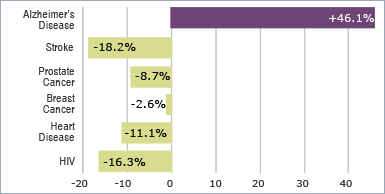
  • While other major causes of death have decreases, Alzheimer's continues to rise rapidly.
info from alz.org

It is evident that we need work towards stopping this very rapidly progressing disease. It affects millions of citizens every year. You can help out the cause by donating to the Alzheimer's association or participating in one of the various memory walks that are held around the country. (= Let's help stop Alzheimer's disease now!!