Monday, May 10, 2010


Final Blog
I am a disciplined mind in the regards that I work steadily over time to improve my skills and understanding. I have learned a set way of writing and over time teachers and mentors have taught me ways of improving these writing skills. Over time I gradually test these new techniques and improve my writing. Over time it gets better and more improved.
The three characteristics that best describe me include: exhibiting curiosity, seeing others points of views, and exhibiting respect for other viewpoints. I am curious about different topics. For instance, I was interested in the details of Alzheimer's disease, so I created my blog to find specific details, treatments, and symptoms. Secondly, I like to take into account others view points. In my blog I have a video and post about a Doctor who believes that he has found a vaccine for Alzheimer's disease. I considered this and then decided on my stance on the subject. Finally, I respect others opinions. I don't believe that this one doctor is correct about his Alzheimer's vaccine. However, I respect his efforts in trying to control the disease and beliefs that this vaccine reverses the disease.
Throughout this blog, the most prevailing realization is that the general publics awareness about Alzheimer's disease is much to low. It is one of the leading cause of death among our population today and yet no one really knows how many it affects. I would go as far to say that most people know or have a family member that has had this desease, yet most don't even know how this disease really works.
I think it is important that Alzheimer's awareness is reaised throughout the United States and the world.
The three characteristics that best describe me include: exhibiting curiosity, seeing others points of views, and exhibiting respect for other viewpoints. I am curious about different topics. For instance, I was interested in the details of Alzheimer's disease, so I created my blog to find specific details, treatments, and symptoms. Secondly, I like to take into account others view points. In my blog I have a video and post about a Doctor who believes that he has found a vaccine for Alzheimer's disease. I considered this and then decided on my stance on the subject. Finally, I respect others opinions. I don't believe that this one doctor is correct about his Alzheimer's vaccine. However, I respect his efforts in trying to control the disease and beliefs that this vaccine reverses the disease.
Throughout this blog, the most prevailing realization is that the general publics awareness about Alzheimer's disease is much to low. It is one of the leading cause of death among our population today and yet no one really knows how many it affects. I would go as far to say that most people know or have a family member that has had this desease, yet most don't even know how this disease really works.
I think it is important that Alzheimer's awareness is reaised throughout the United States and the world.
polls analysis
Both the polls have led to an obvious conclusion. The general population does not know much about alzheimer's or its growing place in our society. These polls show that people need to become more aware of this disease, its symptoms, and its treatments. Maybe this knowledge could lead to earlier diagnosis' in family members, and therefore help slow the progression of the disease from the start.
Friday, May 7, 2010
Video: The Alzheimer's vaccine
Hey everybody, if you haven't already you should check out the new video I added. It is Dr.Schenk who is explaining his new vaccine that he believes helps reverses the effects of Alzheimer's. He believes that people that aren't taking the medicine are refusing to help their helath. Do you think this new vaccine can reverses this demtia disease?? Watch the video and decide what you think.
I personally believe that if this vaccine was really effective, that more doctors would be behind this treatment. Also, I believe that this vaccine would be very publicly heard of. However, this video is the first I have heard of this vaccine at all. I think this doctor and his vaccine are lacking merit. Watch this short video and see what you think.
I personally believe that if this vaccine was really effective, that more doctors would be behind this treatment. Also, I believe that this vaccine would be very publicly heard of. However, this video is the first I have heard of this vaccine at all. I think this doctor and his vaccine are lacking merit. Watch this short video and see what you think.
Monday, May 3, 2010
Does your personality affect your brain's aging?

Yes!! New research shows that one's personality might affect their brain's aging. They have found a direct correlation between brain volume and age. This was especially prominent in the emotional and social processing regions of the brain. The study showed that there was lower amounts of Grey material in the brain of those that ranked high in the neuroticism traits. Whereas, there was a higher volume of Grey matter in those who ranked high in the conscientious traits. There are many studies like this going on trying to figure out what causes Alzheimer's and ways to treat and prevent it. So far the studies have not given much help, but as they continue the studies and monitor how the patients are doing they hope there will be a correlation between these two different personality types.
Treatments for Alzheimer's
There is no cure for Alzheimer's however there are treatments that help slow the progression for the disease. Those that suffer from Alzheimer's have low levels of acetylcholine. This is an important chemical in the brain the helps with nerve cell communication. Cholinesterase inhibitors help to slow down the metabolic breakdown of acetylcholine. This allows more of the acetylcholine chemical to remain available for cell communication. These medications will help slow the progression of the disease, but it does not stop it. It is also only available for patients in the beginning to moderate stages of the disease.
These are the inhibitors that are proven to help slow Alzheimer's down:
Remember you can donate and help the cause at caring.com or alz.org (=
These are the inhibitors that are proven to help slow Alzheimer's down:
- Razadyne® (galantamine)
- Exelon® (rivastigmine)
- Aricept® (donepezil)
- Cognex® (tacrine)
Remember you can donate and help the cause at caring.com or alz.org (=
Do you or have you every known anyone with Alzheimer's? If so you should go to caring.com where you can create a ribbon in honor of your loved one who is suffering from Alzheimer's disease. At this site, you create a ribbon and then copy and paste the url to a website or blog. For every ribbon posted, caring.com will donate $10.00 to the Alzheimer's Association. This is free and helps raise money for research on this deadly dementia. If you don't know anyone who's suffered you can simply donate a ribbon the the cause or research for the disease. Creating a ribbon is free to and it only takes a few minutes. Please help Alheimer's research now!! (=
 This illustration shows how Alzheimer's Disease affects the brain. There is a distinct difference between the healthy brain and the mildly affected one, not to mention the difference between the healthy and severely affected one. This picture shows that the cortical shrinks and the hippocampus shrinks while the ventricles become enlarged.
Although the cause of Alzheimer's is still unknown and therefor there no cures, it is known that genetics and age play a very large role in this disease. Getting very scientific, it is found that there is a correlation between those with three copies of chromosome 21 and Alzheimer's patients. However, it is still being researched if it is a major factor or not. Also, there is a gene on chromosome 19 that makes protein called apolipoprotein E4 is especially common in people who have Alzheimer's Disease. However it too has not been directly pointed out as a cause of the disease.
Researchers are still working toward finding a cure and are continually trying new treatments for patients of the disease.
Monday, April 19, 2010
How to spend time with an Alzheimer's patient
The following is a list of ideas from alz.org on things you can do with an Alzheimer's patient. They might be losing their memory, but that doesn't mean they can't spend time with you. Here's a few ideas of activities you can do with them.
- read a book out loud to them
- bake cookies
- take pictures and make a collage
- work in the garden
- look at old family photo albums
- have them visit with a pet
- ask them about siblings
- ask them about old memories
- go for a walk
- make a bird feeder
- watch a movie
- ask them to participate in a favorite hobby with you
- ask the person about their favorite things
Friday, April 16, 2010
The stages of Alzheimer's
Stage 1: | No impairment (normal function) |
|
| Unimpaired individuals experience no memory problems and none are evident to a health care professional during a medical interview. |
Stage 2: | Very mild cognitive decline (may be normal age-related changes or earliest signs of Alzheimer's disease) |
|
| Individuals may feel as if they have memory loss and lapses, especially in forgetting familiar words or names or the location of keys, eyeglasses or other everyday objects. But these problems are not evident during a medical examination or apparent to friends, family or co-workers. |
| Mild cognitive decline | |
|
| Friends, family or co-workers begin to notice deficiencies. Problems with memory or concentration may be measurable in clinical testing or discernible during a detailed medical interview. Common difficulties include:
|
| Moderate cognitive decline | |
|
| At this stage, a careful medical interview detects clear-cut deficiencies in the following areas:
|
| Moderately severe cognitive decline | |
|
| Major gaps in memory and deficits in cognitive function emerge. Some assistance with day-to-day activities becomes essential. At this stage, individuals may:
|
| Severe cognitive decline | |
|
| Memory difficulties continue to worsen, significant personality changes may emerge and affected individuals need extensive help with customary daily activities. At this stage, individuals may:
|
| Very severe cognitive decline | |
|
| This is the final stage of the disease when individuals lose the ability to respond to their environment, the ability to speak and, ultimately, the ability to control movement.
|
Thursday, April 15, 2010
Did you know...
- 5.3 million Americans are currently living with Alzheimer's today.
- Alzheimer's is the 7th leading cause of death in the U.S.
- Alzheimer's is the most common form of dementia, it accounts for 50-80% for dementia cases
- There is no cure for this disease right now.
- Every 70 seconds someone develops Alzheimer's.
- Africa-Americans are two times more likely than whites and Hispanics are 1.5 times more likely than whites to get the disease.
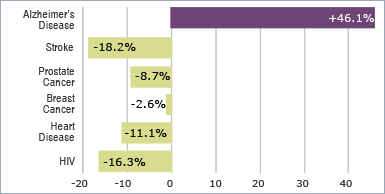
- While other major causes of death have decreases, Alzheimer's continues to rise rapidly.
It is evident that we need work towards stopping this very rapidly progressing disease. It affects millions of citizens every year. You can help out the cause by donating to the Alzheimer's association or participating in one of the various memory walks that are held around the country. (= Let's help stop Alzheimer's disease now!!

Subscribe to:
Posts (Atom)